



Good morning, and welcome to Day 27.
We only have three days left after today, and my goal for this final stretch is simple:
to leave you with enough clarity, momentum, and trust in yourself to actually go and write this book.
I know I said at the beginning of the challenge that I’d be inviting you into the Academy at the end, and I am. You’ve seen glimpses of it, and yesterday I shared a walkthrough so you could see how it works.
But I also know that the Academy won’t be right for everyone. Timing, finances, capacity…there are a bunch of good reasons why now might not be your moment.
So the next few days are about making sure that whether you join the Academy or not, you understand what comes next in the story and how to move forward on your own.
The Hero’s Journey is a circle
Today we’re looking at the final step of the Hero’s Journey—the one we haven’t fully unpacked yet—and how it connects back to the beginning.
I’ve included a visual of the journey below so you can see it as a circle.
This structure mirrors how human change actually works.
We don’t transform once and stay finished forever. We move through cycles of disruption, resistance, growth, collapse, and renewal again and again. If a lesson hasn’t quite landed, life tends to send us back around the loop.
That’s why this structure shows up across cultures, centuries, and myth traditions.
It was Joseph Campbell—an anthropologist, folklorist, and literary scholar—who studied myths and stories from around the world and noticed that they all followed this same underlying pattern, regardless of geography or contact with other cultures.
It resonates because it’s human.
A quick recap of the full journey
You’ve already done the hard part, but let’s quickly orient ourselves.
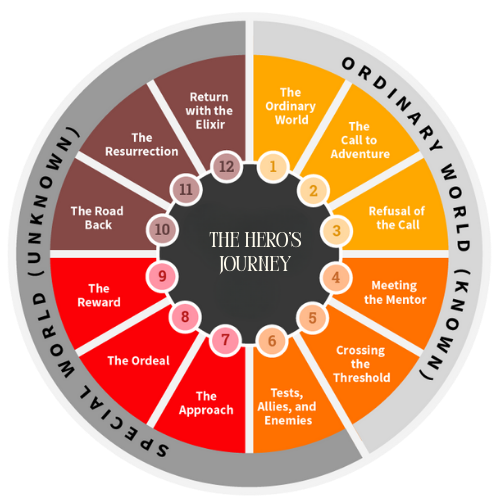
Ordinary world: the Hero’s starting point, where a core flaw keeps them safe but stuck
Call to adventure: something destabilises that world
Refusal of the call: avoidance, resistance, denial
Meeting the mentor: a guide nudges them forward
Crossing the threshold: commitment, even if reluctant
Tests, allies, enemies: the belief is stress-tested
The approach: mounting failure, pressure closing in
The ordeal: catastrophic failure; the belief breaks
The reward: sometimes a truth, sometimes clarity, sometimes hope
The road back: being pulled forward despite exhaustion
The resurrection: the Hero acts from need, not want
Return with the elixir: the Hero returns changed
You’ve plotted through the resurrection because that’s the end of the transformation.
What comes next is less about structure and more about meaning.
The return with the elixir
The return with the elixir is where the Hero comes back to the world they started in, but nothing is the same.
They don’t return to restore the old world; they return because it can never be what it was again.
The elixir is not necessarily a physical object. It can be:
a new belief
a new boundary
a new way of relating
a truth that can now be shared
sometimes, yes, a literal thing that helps others
What matters is that it’s what the Hero needed, not what they wanted…and that it now has value beyond just them.
The Ordinary World has changed because the Hero has changed.
In Finding Nemo, the reef hasn’t transformed, but Marlin has.
In other stories, the entire community is altered by the journey.
Either way, the cycle closes…and quietly begins again.
Why I don’t want you to plot this part
I don’t want you to plan the ending in detail.
Endings work best when they’re discovered through writing rather than decided in advance.
Once you’ve written through the transformation, you will know things about your story that you cannot know right now, and forcing decisions too early is how writers get stuck.
Today’s task
In the comments, answer this:
What is the elixir your Hero brings back?
Not how it plays out or how you’ll write it. Just name the thing.
Is it a belief?
A truth?
A skill?
A way of being that others can now access?
Keep it simple.
Question for reflection
I’ll put this in the reflection thread, but here it is:
What part of your ending feels like it needs to be discovered through writing, rather than decided in advance…and why?
Sit with that because you’ve been working on your writer instincts.
Tomorrow, we’ll shift into the final stretch: what you do next, how you carry this forward, and how to keep writing once the challenge ends.
I’ll see you then.
Xx Shelly


