


Welcome to day one!
I’m so glad we’re finally starting. I’ve been looking forward to this for months.
Whether you signed up recently or put your name down ages ago and then life happened…here we are.
It’s January, it’s a fresh start, and for the next 30 days we’re going to take this one small, manageable step at a time.
These videos are intentionally short. The idea is that you spend 20–30 minutes a day total watching the video and doing the task.
Big things are built in little steps.
By the end of the month, you’ll have a clear, workable blueprint for your book (or screenplay).

What we’re doing today
Today is all about your basic idea, which we’re turning into your story’s premise.
If you came into this challenge with a story idea already, amazing.
If you didn’t, that’s completely fine too.
What matters today isn’t having the perfect idea; it’s choosing one and sticking with it for the next 30 days.
If you’re anything like me, ideas tend to multiply. You follow one for a bit, then another shiny one wanders past, and suddenly you’re off in a different direction.
That’s fun, but it’s also how books never get finished.
So for this month, we’re practising commitment and follow through…even when the tasks feel silly or short.
That means that if you haven’t come in with one project or story in mind, today is the day to pick one and stick with it.
What is an idea?
There’s a book about creativity I really like called Big Magic by Elizabeth Gilbert.
(She’s controversial, I know, but she has some incredible insights on creativity and writing!)
She believes that ideas are living things that are floating around, looking for someone willing to bring them into the world.
When one lands with you, their question becomes: Are you going to take it seriously? And will you follow through?
And if you agree to this contract but don’t hold up your end of the bargain, that little floating idea shrivels and dies, or pops off to find a more motivated partner.
You don’t have to believe this literally for it to be useful. It’s just a helpful way of thinking about the moment when you say:
Okay. I’m choosing you. Let’s see this through.
Premise vs plot vs synopsis (quick clarity)
These three get mixed up all the time, so here’s the simple version:
Premise → one sentence that tells us what the story is about
Plot → the mechanics and chain reaction of events
Synopsis → a longer summary of the whole story, start to finish
Today, we’re only working on the premise, and we’re going to write out our core story in just one sentence.
Examples
Here are four examples I’ll be using a lot during the challenge, because they’re structurally very clean:
Finding Nemo (2003): When his son goes missing, a father fish crosses the ocean to find him.
The Matrix (1999): When a computer hacker learns that reality is an artificial prison, he decides to fight the system.
Star Wars (1977): A farm boy on a remote planet becomes entangled in a rebellion against a tyrannical empire, forcing him out of obscurity and into a much larger conflict.
The Princess Diaries (2001): An awkward teenage girl learns she’s the heir to a European throne and must choose between remaining invisible or stepping into the role of a princess.
Each one tells us:
what disrupts the world
what the story is about
and what kind of movement the story has
All in one sentence.
Your tasks for today
Nothing scary. Just four simple things.
1. Write your premise
Write one sentence that captures the core of your story.
2. Post your premise in the comments
Once you’ve got a version you’re happy with, post it in the comments below this post.
(NOTE: I’m keeping track of everyone’s premises so I know what you’re working on and can help you properly as we go. So DEFINITELY put it there!)
3. Jump into the chat
I’ll be posting a prompt in the chat later today asking:
What did turning your idea into a premise clarify for you about your story?
Spend a little time with that. Talk it through. Help each other. This challenge works best when you don’t do it alone.

4. Extra credit (optional but fun and will be helpful)
There are 4 films I tend to talk about when I discuss story structure, so it will be incredibly helpful for you to have the context.
If you get a chance in the next week, watch one or all of these films. I’ll discuss them more in depth on the 7th.
Finding Nemo (2003)
The Matrix (1999)
Star Wars: A New Hope (1977)
The Princess Diaries (2001)
It’s much easier to point to a 90-minute film than ask you to read five books. Plus, my background was originally in film and story development for a big Hollywood study. That’s where I learned about the tight and important mechanics of story formulas.
Recommended reading (optional)
If you want something inspiring today, I recommend Big Magic by Elizabeth Gilbert.
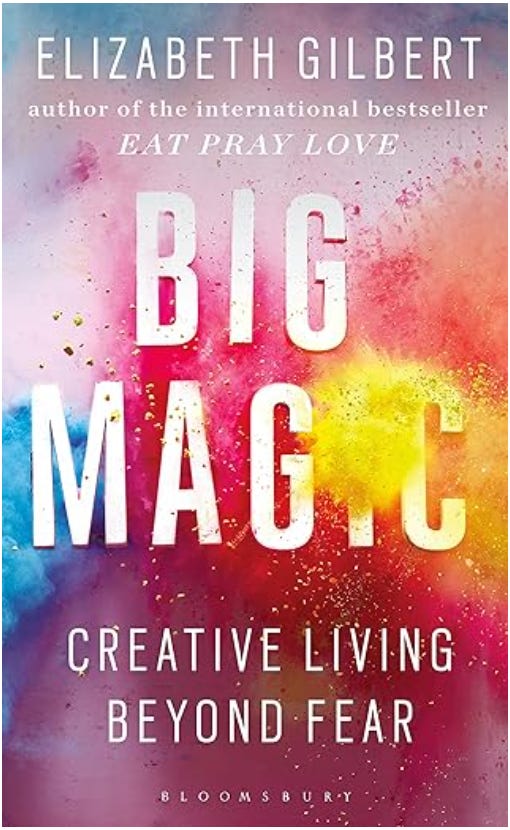
(If you’re able, please consider buying your copy from an independent bookshop…and—if possible—could I please request that you avoid Amazon? Indie shops are so important for our communities and for our minds! The button below will take you to The Canterbury Bookshop, which happens to be the indie bookshop that I own. So if you do choose to buy from this link, my bookshop will receive the commission.)
Before I go…
I’ve absolutely loved getting emails from so many of you already! Hearing what you’re working on, why you signed up, and what you want to change about your creative life this year is the best part about this for me.
Please don’t ever feel weird about emailing me. You can reply to this email, or write directly to: shelly@academyofstory.com.
(If you emailed earlier and didn’t hear back, send it again directly — sometimes long reply chains get messy.)
I’m really excited to do this with you.Let’s get January off to a great start.
See you tomorrow at 5am,
Shelly x


